
Introduction: Is .NET Really Outdated?
For years, a common narrative has circulated in tech discussions: “.NET is outdated.” This perception often stems from its long history and association with earlier Windows-only frameworks. However, this view no longer reflects reality.
Modern .NET has undergone a significant transformation. Today, it is open-source, cross-platform, cloud-native, and continuously evolving, making it one of the most robust ecosystems for enterprise software development.
Despite the emergence of newer frameworks, enterprises across industries continue to rely on dot net development services to power their most critical applications. The reason is simple: when reliability, scalability, and long-term support matter, .NET consistently delivers.
What Defines a Mission-Critical System?
Mission-critical systems are the backbone of enterprise operations. These are applications where failure is not an option.
Examples include:
-
Financial transaction processing systems
-
Healthcare patient management platforms
-
Supply chain and logistics systems
-
Government and defense applications
-
Enterprise resource planning (ERP) systems
Such systems require:
-
High availability and uptime
-
Robust security and compliance
-
Scalability under heavy workloads
-
Long-term maintainability
Choosing the right technology stack for these systems is not about trends—it’s about proven performance and reliability over time. This is where net software development services play a critical role.
The Evolution of .NET: From Legacy to Modern Platform
The perception of .NET as outdated often ignores its evolution.
Key Transformations:
-
.NET Core → Unified .NET (5/6/7/8)
A modern, high-performance framework supporting cross-platform development -
Open-Source Ecosystem
.NET is now fully open-source, encouraging innovation and community contributions -
Cross-Platform Capabilities
Applications can run on Windows, Linux, and macOS -
Cloud-Native Architecture
Deep integration with cloud platforms, especially Microsoft Azure -
Microservices and Containerization Support
Seamless deployment using Docker and Kubernetes
Modern asp dot net development services leverage these advancements to build scalable, distributed systems that meet enterprise demands.
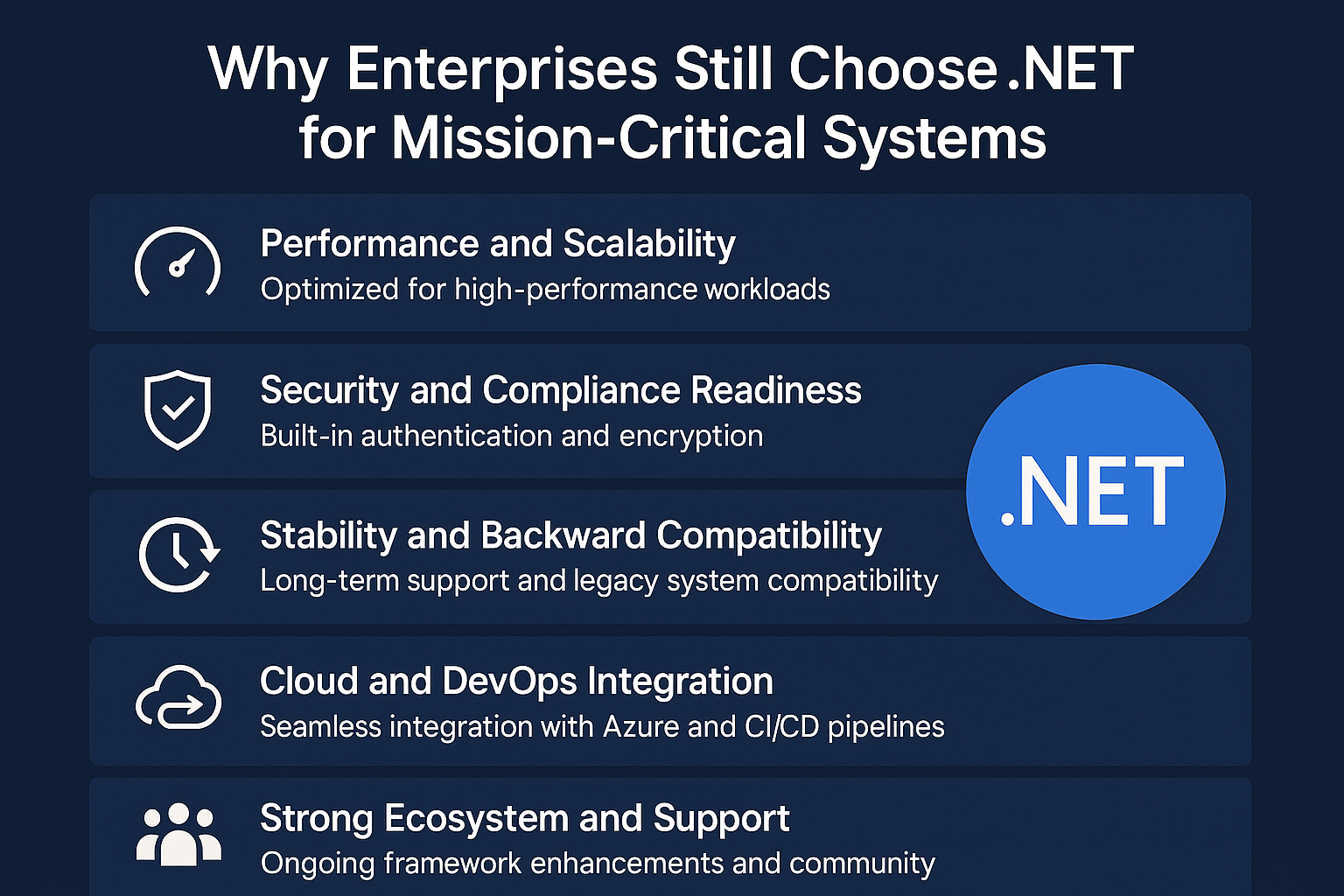
Why Enterprises Continue to Choose .NET
1. Performance and Scalability
Modern .NET frameworks are engineered to support high‑performance workloads at enterprise scale. An efficient runtime combined with advanced memory management ensures optimal resource utilization, even under heavy demand.
Built‑in support for asynchronous programming enables applications to execute tasks concurrently without blocking processes, resulting in faster response times and improved user experiences. This architecture allows APIs and microservices to achieve high throughput while maintaining stability.
With the ability to scale seamlessly, .NET‑based systems can handle millions of concurrent users, making the framework a reliable choice for high‑traffic applications and large‑scale digital platforms.
Using asp net development services, enterprises can build systems that scale seamlessly as demand grows.
2. Security and Compliance Readiness
Security is a non‑negotiable requirement for mission‑critical enterprise systems, and the .NET ecosystem is built with this priority at its core. The framework includes robust authentication and authorization mechanisms that help ensure secure access control across applications and services.
Advanced encryption and data protection features safeguard sensitive information both at rest and in transit, while Microsoft’s regular security updates help organizations stay protected against evolving threats. In addition, .NET provides strong compliance support for regulatory standards such as GDPR, HIPAA, and PCI‑DSS, making it suitable for highly regulated environments.
For industries like finance and healthcare, where security, data privacy, and regulatory adherence are critical, professional .NET development services continue to be a preferred and trusted choice.
3. Stability and Backward Compatibility
Unlike many rapidly evolving frameworks, .NET places a strong emphasis on long‑term stability, making it a dependable choice for enterprise environments. Its robust backward compatibility ensures that legacy systems continue to function reliably, even as newer versions of the framework are introduced.
The availability of Long‑Term Support (LTS) releases provides predictable upgrade cycles, allowing organizations to plan updates with confidence and minimal risk. This stability enables enterprises to modernize their applications incrementally, adopting new features and improvements without disrupting existing operations or business continuity.
This stability is a key reason organizations continue to invest in net development services.
4. Cloud and DevOps Integration
Modern enterprise systems depend on seamless integration with cloud platforms and DevOps pipelines to achieve agility, scalability, and operational efficiency. The .NET ecosystem is built to support this requirement by offering native integration with Microsoft Azure, enabling organizations to deploy, manage, and scale applications with ease.
Support for CI/CD pipelines allows teams to automate builds, testing, and deployments, ensuring faster and more reliable continuous delivery. .NET also aligns well with Infrastructure as Code (IaC) practices, making it easier to provision and manage infrastructure consistently across environments. In addition, built‑in compatibility with containerized deployments and Kubernetes simplifies the orchestration of modern, cloud‑native applications.
Together, these capabilities enable organizations to build agile, scalable, and resilient systems using professional ASP.NET development services, while maintaining speed, reliability, and control across the entire development lifecycle.
5. Strong Microsoft Ecosystem and Long-Term Support
Microsoft’s continued investment in the .NET platform ensures its long‑term viability and relevance for enterprise development. Regular framework updates and ongoing enhancements keep .NET aligned with evolving technology standards, performance expectations, and security requirements.
The platform is supported by extensive documentation, mature development tools, and a rich ecosystem that improves productivity and reduces development friction. Seamless integration with enterprise solutions such as Microsoft Azure, Power Platform, and Dynamics further strengthens .NET’s position as a backbone for large‑scale digital transformation initiatives.
In addition, a vast global developer community contributes to continuous innovation, open‑source libraries, and shared best practices, making problem‑solving faster and knowledge more accessible. A reliable .NET development company can effectively leverage this ecosystem to deliver secure, scalable, and enterprise‑grade solutions that stand the test of time.
How ASP.NET Powers High-Performance Enterprise Systems
ASP.NET, particularly ASP.NET Core, plays a critical role in modern enterprise application development by delivering speed, scalability, and architectural flexibility.
Built for high‑performance web application development, ASP.NET Core enables rapid execution and efficient handling of enterprise‑scale workloads. Its API‑first approach supports seamless integrations with third‑party systems, mobile applications, and cloud services, making it ideal for connected digital ecosystems.
The framework’s lightweight and modular architecture allows developers to build optimized applications without unnecessary overhead, while native support for microservices and distributed systems makes it well‑suited for complex, large‑scale environments.
With professional ASP.NET development services, organizations can develop real‑time applications that demand instant data processing, high‑traffic web platforms capable of handling millions of users, and scalable SaaS solutions designed for long‑term growth.
Overall, ASP.NET empowers enterprises to meet demanding performance requirements while maintaining the flexibility needed to adapt to evolving business and technology landscapes.
The Role of a Trusted ASP.NET Development Company
While .NET provides the foundation, successful implementation depends on expertise.
A professional asp net development company brings:
-
Deep understanding of enterprise architectures
-
Experience in handling mission-critical systems
-
Proven modernization and migration strategies
-
Strong focus on security, scalability, and performance
Choosing the right net development company ensures that applications are not only built correctly but also optimized for long-term success.
Business Benefits of Professional .NET Development Services
-
Partnering with experienced .NET development professionals delivers measurable business advantages across performance, cost, and scalability.
-
Reduced Risk:
Established development methodologies significantly lower the chances of project failure, while comprehensive testing practices ensure high system reliability and consistent performance. -
Faster Time‑to‑Market:
Streamlined development processes, supported by pre‑built frameworks and reusable components, enable quicker delivery without compromising quality. -
Lower Total Cost of Ownership:
Optimized architecture reduces ongoing maintenance expenses and ensures long‑term platform stability, resulting in better value over time. -
Future‑Ready Architecture:
Scalable system designs adapt effortlessly to evolving business requirements and allow seamless integration with emerging technologies.
These benefits make net development services a strategic investment rather than just a technical decision.
Conclusion: .NET as a Future-Ready Enterprise Platform
The idea that .NET is outdated is a misconception rooted in its past—not its present.
Today, .NET is a modern, high-performance, and enterprise-proven platform that continues to evolve with the needs of businesses. Its combination of scalability, security, stability, and ecosystem support makes it an ideal choice for mission-critical systems.
For enterprises evaluating long-term technology strategies, dot net development services offer a reliable path forward—one that balances innovation with stability.
In a world where system downtime can mean significant financial and reputational loss, choosing a platform with a proven track record is essential. .NET remains that platform—trusted by enterprises, supported by Microsoft, and ready for the future.
